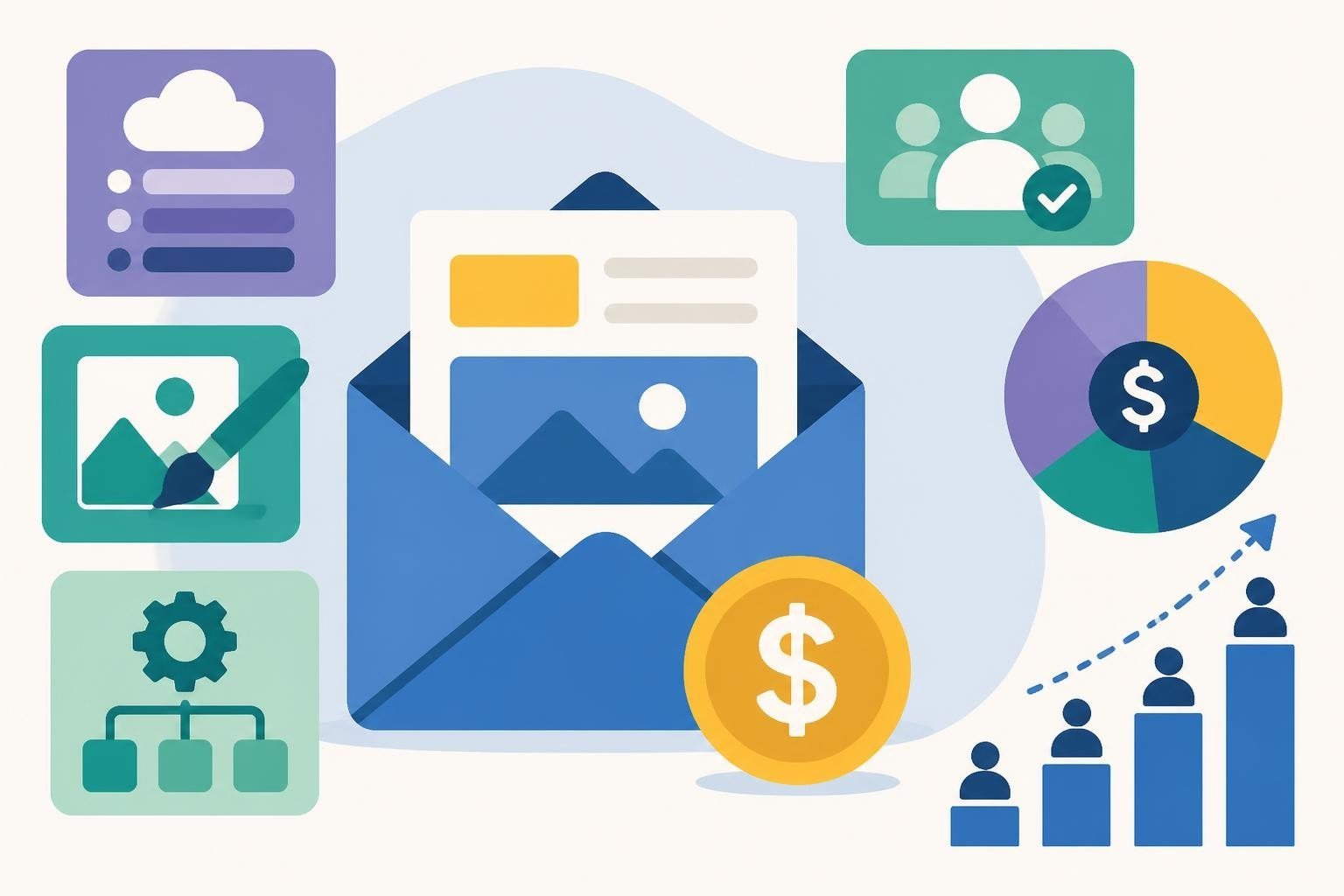
Email marketing remains one of the highest-ROI digital channels available to businesses in 2026, but understanding the true email marketing cost requires looking beyond the monthly platform subscription. From design and development resources to list management and deliverability infrastructure, the total investment varies dramatically based on your subscriber count, sending frequency, and feature requirements. Whether you're launching your first campaign or evaluating your current provider, knowing exactly where your budget goes helps you maximize returns and avoid expensive surprises.
Breaking Down Email Marketing Cost Components
The total email marketing cost encompasses multiple layers of investment, each contributing to your campaign's success and efficiency. Understanding these components helps you budget accurately and identify areas where you can optimize spending.
Platform subscription fees form the foundation of your email marketing cost. Most providers use tiered pricing based on subscriber count, with additional charges for premium features like advanced automation, A/B testing, or dedicated IP addresses. According to WebFX’s comprehensive pricing analysis, basic plans typically start between $10 and $20 monthly for lists under 500 subscribers, while enterprise-level accounts with hundreds of thousands of contacts can exceed $1,500 monthly.
Monthly Platform Pricing Breakdown
Different email service providers structure their pricing models in distinct ways. Here's how the major cost factors stack up:
| Subscriber Range | Basic Tier | Mid-Tier | Enterprise |
|---|---|---|---|
| 0-1,000 | $10-$20/mo | $30-$50/mo | Custom |
| 1,000-5,000 | $25-$45/mo | $60-$90/mo | Custom |
| 5,000-10,000 | $50-$80/mo | $100-$150/mo | Custom |
| 10,000-50,000 | $100-$200/mo | $200-$400/mo | $500+ |
| 50,000+ | $250+ | $500+ | $1,500+ |
Beyond the base subscription, creative and design costs add significantly to your email marketing cost. Professional email templates range from $20 for simple designs to $500+ for custom-coded responsive templates with advanced functionality. If you maintain in-house designers, factor in their hourly rates multiplied by production time, or budget for freelance designers at $50-$150 per hour.

Copywriting and content creation represent another crucial expense category. Whether you hire freelance copywriters at $100-$500 per email, employ full-time content specialists, or dedicate internal team hours, content production directly impacts your email marketing cost structure. HubSpot’s email marketing guide suggests allocating 20-30% of your total email budget to content development for optimal results.
Platform Selection and Its Impact on Cost
Choosing the right email marketing platform dramatically affects both your immediate expenses and long-term email marketing cost trajectory. The three primary options-dedicated email service providers, all-in-one marketing platforms, and transactional email services-each carry distinct pricing implications.
Dedicated email service providers like AWeber, GetResponse, and Moosend typically offer the most transparent pricing for businesses focused primarily on newsletter and promotional email campaigns. These platforms price based on subscriber count and feature tier, making budgeting straightforward. For businesses evaluating options, an independent comparison of AWeber, GetResponse and Moosend provides real pricing data, sending limits, and automation capabilities with calculators that show exact costs at your specific list size.
Feature Sets and Cost Implications
- Basic automation: Included in most mid-tier plans ($30-$80/month)
- Advanced segmentation: Often requires premium tiers (adds $20-$100/month)
- A/B testing: Sometimes limited on basic plans (full access adds $15-$50/month)
- Dedicated IP address: Typically $30-$50/month additional
- Custom domain authentication: Usually included, sometimes $10-$20/month
- Priority support: Premium feature adding $50-$200/month
All-in-one marketing platforms bundle email with CRM, landing pages, and other tools. While this seems efficient, your email marketing cost within these suites often exceeds standalone providers when you calculate the email-specific portion. A $300/month all-in-one platform might allocate $100-$150 to email functionality you could purchase separately for $60-$80.
Transactional email services like SendGrid or Mailgun charge primarily by send volume rather than subscriber count. For businesses sending high volumes to smaller lists, Mailgun’s email ROI analysis demonstrates how this pricing model can reduce email marketing cost by 40-60% compared to traditional subscriber-based pricing.
Hidden Costs That Inflate Your Email Budget
Beyond obvious line items, several hidden expenses significantly increase total email marketing cost when overlooked during initial budgeting. Identifying these early prevents budget overruns and financial surprises.
List management and hygiene require ongoing investment. Email verification services charge $0.004-$0.01 per email address verified, meaning a 50,000-contact list verification costs $200-$500 quarterly. However, Validity’s 2025 deliverability benchmarks show that poor list hygiene reduces inbox placement by 12-18%, effectively wasting that portion of your email marketing cost on messages that never reach recipients.
Labor and Personnel Costs
The human capital required to execute email marketing campaigns often represents the largest component of total email marketing cost, yet businesses frequently underestimate this investment.
| Role | Time Investment | Hourly Rate | Monthly Cost |
|---|---|---|---|
| Email Strategist | 10-20 hrs/mo | $75-$150/hr | $750-$3,000 |
| Designer/Developer | 8-15 hrs/mo | $60-$120/hr | $480-$1,800 |
| Copywriter | 10-16 hrs/mo | $50-$125/hr | $500-$2,000 |
| Data Analyst | 4-10 hrs/mo | $70-$140/hr | $280-$1,400 |
For a typical mid-sized business sending 8-12 campaigns monthly, total labor costs range from $2,000 to $8,200 per month, dwarfing the $100-$400 platform subscription fee.
Integration and development costs emerge when connecting your email platform to CRMs, e-commerce systems, or custom applications. Simple integrations through native connectors cost nothing beyond platform fees, but custom API development runs $2,000-$15,000 depending on complexity. Ongoing maintenance and updates add 15-20% of initial development costs annually.
Deliverability Infrastructure and Its Cost Implications
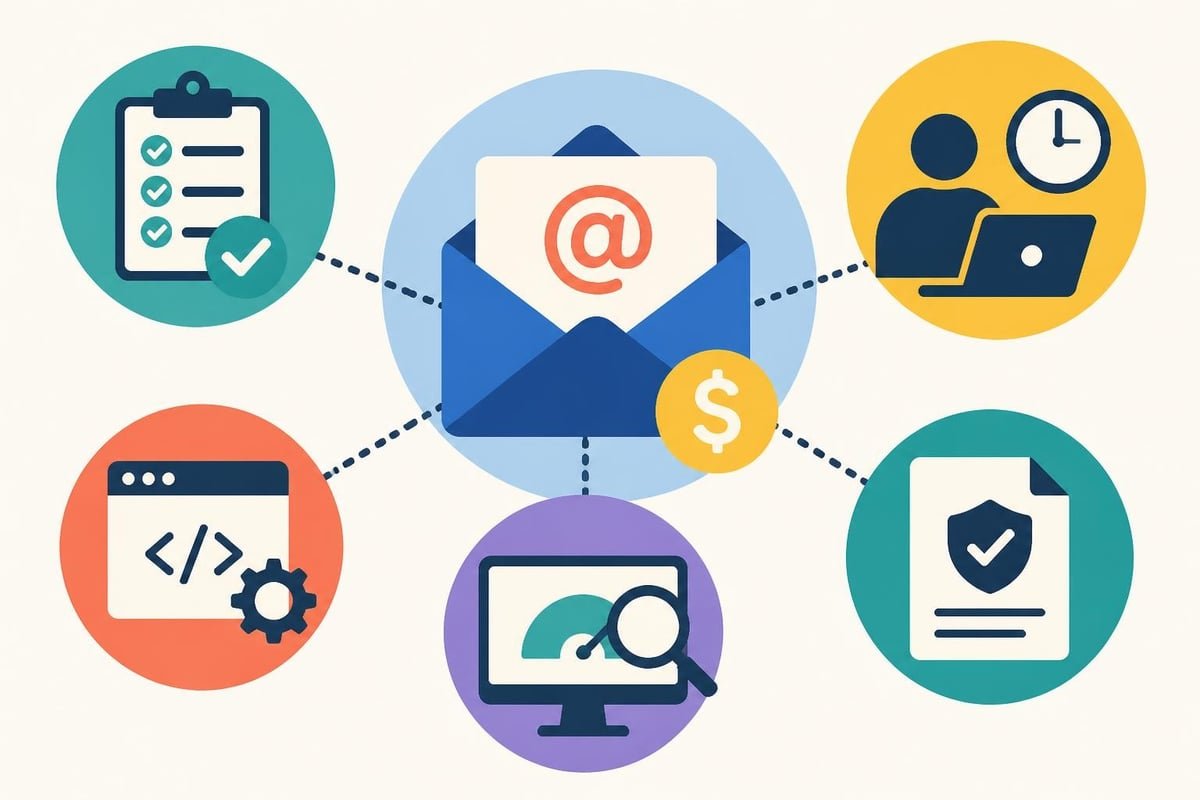
Email deliverability directly affects the effective email marketing cost per successful delivery. Investing in proper authentication, sender reputation, and monitoring reduces waste and improves ROI substantially.
Domain authentication setup (SPF, DKIM, DMARC) costs little in direct fees but requires technical expertise. Many businesses spend $200-$500 on initial setup through consultants or IT contractors. The Twilio blog’s breakdown of email marketing costs emphasizes that this one-time investment prevents deliverability issues that could cost thousands in lost revenue.
Dedicated IP addresses add $30-$50 monthly to email marketing cost but provide essential reputation control for high-volume senders. Shared IPs come free with most platforms, but one bad neighbor can tank your deliverability across all campaigns. Businesses sending 100,000+ emails monthly typically see dedicated IPs reduce spam folder placement by 8-15%.
Monitoring and Testing Tools
- Inbox placement testing: $50-$200/month for tools like Litmus or Email on Acid
- Deliverability monitoring: $100-$300/month for advanced platforms
- Spam filter testing: Often included in platforms, standalone tools $30-$80/month
- Email preview testing: $30-$100/month depending on device coverage
- Analytics enhancement: $50-$500/month for advanced attribution
According to Litmus’ 2026 State of Email report, companies using comprehensive testing and monitoring tools achieve 23% higher email ROI despite the additional email marketing cost these tools represent.
Scaling Considerations and Cost Efficiency
As your subscriber list grows, email marketing cost doesn't scale linearly. Understanding these dynamics helps you budget for growth and identify efficiency opportunities.
Most email platforms increase pricing in tiers, creating cost jumps at specific thresholds. A list growing from 9,800 to 10,200 subscribers might jump from the $80/month tier to the $140/month tier-a 75% increase for just 4% more subscribers. Strategic list management around these thresholds can save hundreds monthly.
Volume discounts and annual commitments significantly reduce email marketing cost for established programs. Platforms typically offer 15-25% discounts for annual prepayment versus month-to-month billing. For a business paying $200 monthly, annual commitment saves $360-$600 yearly-money better spent on creative development or advanced features.
Cost Per Email Sent vs. Cost Per Subscriber
Different pricing models favor different sending patterns:
| Sending Pattern | Subscriber Model | Volume Model | Cost Advantage |
|---|---|---|---|
| Daily to 10K list | $100/mo | $80/mo | Volume 20% cheaper |
| Weekly to 50K list | $250/mo | $180/mo | Volume 28% cheaper |
| 2x/month to 100K | $600/mo | $850/mo | Subscriber 29% cheaper |
| Daily to 5K active | $60/mo | $120/mo | Subscriber 50% cheaper |
Businesses with high sending frequency to smaller engaged segments often find volume-based pricing reduces email marketing cost substantially, while those maintaining large lists but sending infrequently benefit from subscriber-based models.
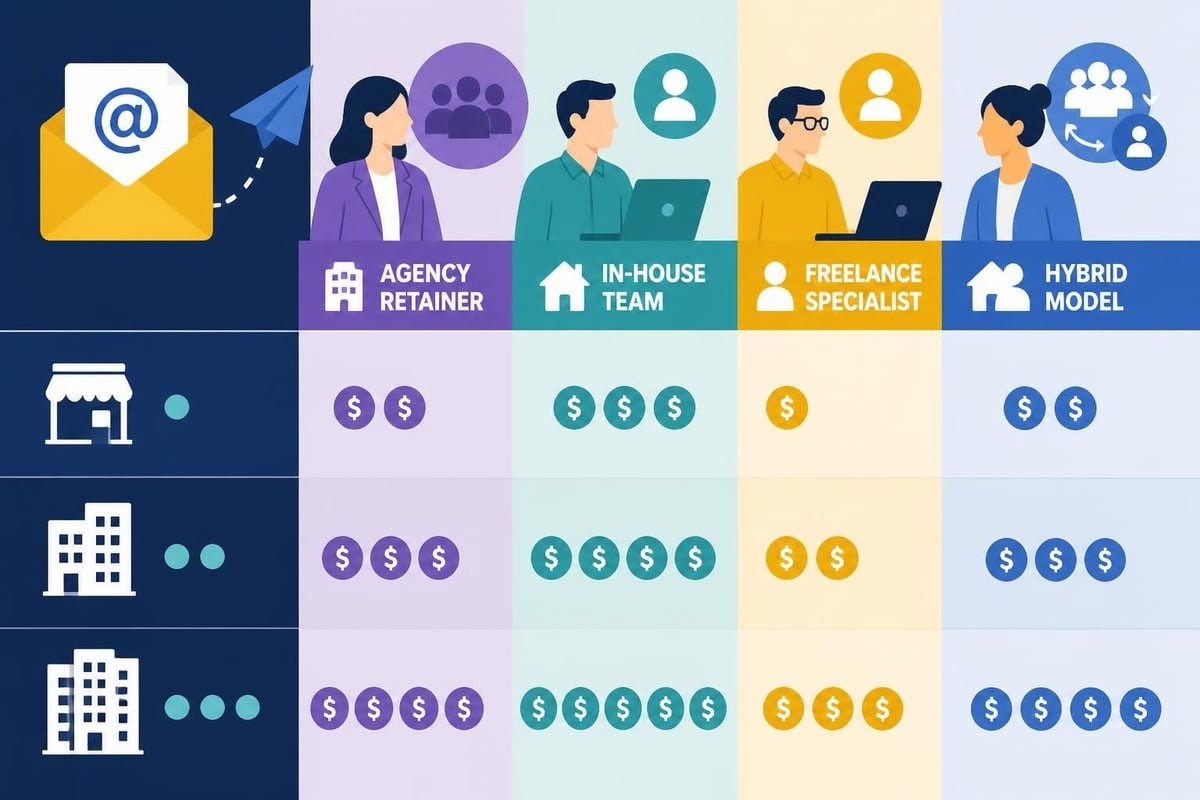
Agency vs. In-House Cost Comparison
Deciding between managing email marketing internally or outsourcing to agencies fundamentally reshapes your email marketing cost structure and resource allocation.
Agency pricing models typically fall into three categories: monthly retainers ($1,500-$10,000+), per-campaign fees ($500-$3,000 per email), or performance-based arrangements. Omnisend’s comprehensive cost guide notes that full-service agency relationships for mid-market companies average $3,000-$7,000 monthly including platform costs, creative, strategy, and execution.
In-house teams provide more control and brand intimacy but require higher fixed costs. A single dedicated email marketing manager costs $50,000-$85,000 annually in salary alone, plus benefits, platform costs, and tools-bringing total email marketing cost to $65,000-$110,000 yearly before any additional creative or development support.
Break-Even Analysis
For many businesses, the decision point falls around list size and campaign volume:
- Under 5,000 subscribers, 2-4 campaigns monthly: Self-service with freelance support ($300-$800/month total) offers best value
- 5,000-25,000 subscribers, 8-12 campaigns monthly: Dedicated in-house coordinator ($5,000-$7,000/month fully loaded) becomes cost-effective
- 25,000-100,000 subscribers, daily sends: Specialized agency ($4,000-$8,000/month) or small in-house team (2-3 people, $12,000-$18,000/month)
- 100,000+ subscribers, complex automation: In-house team with agency support for specialized projects provides optimal flexibility
Calculating True ROI Against Your Email Marketing Cost
Understanding whether your email marketing cost delivers appropriate returns requires tracking metrics beyond basic open and click rates. Comprehensive ROI calculation factors in all cost components against revenue attribution.
Total cost calculation should include platform fees, labor (internal and external), creative production, list acquisition and management, tools and integrations, and allocated overhead. For a typical mid-sized e-commerce business, monthly email marketing cost breaks down roughly as: 35% labor, 25% platform and tools, 20% creative production, 15% list acquisition, 5% miscellaneous.
Revenue attribution varies by business model. E-commerce companies track direct email-driven purchases, while B2B organizations measure influenced pipeline and assisted conversions. Forrester’s email marketing vendor research found that companies with mature attribution models reported 40% higher perceived email ROI than those using last-click attribution alone.
Key Metrics for Cost Justification
- Cost per email sent: Total monthly cost / emails delivered
- Cost per engagement: Total monthly cost / (opens + clicks)
- Cost per conversion: Total monthly cost / conversions attributed to email
- Customer acquisition cost (email channel): Total annual email cost / new customers from email
- Lifetime value multiplier: Average LTV of email subscribers vs. non-subscribers
Healthy benchmarks for 2026 suggest email marketing cost per conversion should remain 60-80% below your average across all digital channels. Email-acquired customers typically show 15-25% higher lifetime value than other channels, justifying premium investment in list building and engagement.
Platform-Specific Cost Considerations
Different email marketing platforms structure costs uniquely, making direct comparison challenging without understanding each provider's pricing philosophy and hidden charges.
Feature paywalls vary dramatically between providers. Some platforms include automation, segmentation, and A/B testing in base plans, while others gate these behind premium tiers that double or triple your email marketing cost. When evaluating platforms, list every feature you'll actually use and verify its availability at each pricing tier.
Overage charges create budget uncertainty with subscriber-based pricing. Most platforms charge premium rates when you exceed your plan's subscriber limit-sometimes 2-3x the normal per-subscriber rate. A business fluctuating between 9,500 and 10,500 subscribers might face $30-$60 in overage fees monthly on top of base costs.
Pricing Model Comparison
| Provider Type | Base Model | Growth Penalty | Feature Access | Best For |
|---|---|---|---|---|
| Subscriber-based | Per contact | High at tiers | Graduated | Consistent lists |
| Email-based | Per send | Moderate | Full access | Variable frequency |
| Contact + Send | Hybrid | Low | Tiered | Growing businesses |
| Flat rate | Unlimited | None | Full access | High volume |
Businesses experiencing rapid list growth should prioritize platforms with gentler tier transitions or contact-plus-send models that spread email marketing cost increases across both dimensions rather than hitting thresholds that double fees overnight.
Budgeting for Email Marketing in 2026
Creating a realistic email marketing budget for 2026 requires projecting growth, anticipating feature needs, and building flexibility for testing and optimization initiatives.
Annual budget planning should allocate 12-18% of total marketing spend to email for businesses where it represents a primary customer communication channel. Consumer brands typically invest 15-20%, while B2B companies with longer sales cycles allocate 10-14%. Your email marketing cost as a percentage of revenue typically ranges from 0.5-2% depending on industry and maturity.
Start-up costs for new email programs run higher than ongoing operations. Expect to invest $2,000-$8,000 in initial setup including platform selection and configuration, template development, initial automation workflows, list acquisition, and team training. These one-time costs amortize over 12-18 months in realistic budgeting.
Monthly Budget Template
A growing e-commerce business with 15,000 subscribers might budget:
- Platform subscription: $140/month
- Email designer (freelance, 12 hrs): $840/month
- Copywriter (freelance, 14 hrs): $1,120/month
- List verification (quarterly average): $67/month
- Testing and monitoring tools: $80/month
- Integration maintenance: $100/month
- Total email marketing cost: $2,347/month or $28,164/year
This business should track target metrics of 8-12 campaigns monthly, 22-28% open rate, 3-4% click rate, and $8-12 revenue per email sent to justify this investment level.
Cost Optimization Strategies
Reducing email marketing cost without sacrificing results requires strategic choices about platforms, processes, and resource allocation.
Platform optimization starts with honest feature assessment. Many businesses pay for advanced automation they never implement or enterprise support they rarely use. Downgrading from a $200/month premium plan to a $120/month mid-tier plan while maintaining actual feature usage saves $960 annually with zero impact on performance.
Consolidating tools reduces both direct costs and integration complexity. Businesses using separate providers for email marketing, SMS, and landing pages might pay $300+ monthly across platforms, while unified solutions cost $180-$220 for equivalent functionality, cutting email marketing cost by 30-40% while simplifying workflows.
Efficiency Tactics
- Template libraries: Build reusable components reducing design time by 60-70%
- Automation workflows: Replace manual campaign sends with triggered sequences
- List segmentation: Send smaller, targeted campaigns instead of mass blasts
- Content repurposing: Adapt existing blog and social content for email
- Batch production: Create multiple emails in focused sessions reducing setup overhead
- Performance culling: Remove inactive subscribers reducing platform costs while improving deliverability
Regular audits of your email marketing cost allocation identify waste and optimization opportunities. Quarterly reviews should examine platform feature usage, labor efficiency, creative production costs, and ROI by campaign type, shifting resources toward highest-performing initiatives.
International and Compliance Costs
Operating email marketing programs across multiple regions introduces additional email marketing cost through compliance requirements, localization needs, and regulatory complexity.
GDPR, CAN-SPAM, and CASL compliance require legal review, consent management systems, and documentation processes. Initial compliance setup costs $1,500-$5,000 for SMBs working with specialized attorneys, while ongoing compliance monitoring and updates add $200-$500 monthly for multi-region operations.
Consent management platforms that integrate with email systems cost $50-$300 monthly depending on contact volume and feature requirements. These specialized tools track opt-in sources, manage preference centers, and document consent proof-essential for defending against regulatory challenges that could cost $10,000-$50,000+ in fines and legal fees.
Regional Cost Factors
- Translation and localization: $0.08-$0.15 per word for professional translation
- Regional email infrastructure: Dedicated IPs in multiple regions ($30-$50 each)
- Local domain authentication: Additional DNS configuration ($100-$300 setup)
- Regional deliverability monitoring: Extended tool coverage ($50-$150/month)
- Compliance consulting: Ongoing legal review ($500-$2,000/quarter)
Businesses operating in the EU, Canada, Australia, and other regulated markets should budget an additional 20-35% in email marketing cost over US-only operations to cover these requirements properly.
Understanding your complete email marketing cost enables smarter platform selection, realistic budgeting, and strategic resource allocation that maximizes return on investment. As you evaluate different channels for your marketing budget, remember that email consistently delivers some of the highest ROI across digital tactics when executed with proper tools and strategy. Just as email marketing requires comparing platforms to find the right pricing and features for your needs, choosing social media growth services demands careful comparison of providers on price, delivery speed, and platform coverage. MarketDeals offers independent comparisons with live calculators to help you make informed decisions across both email marketing platforms and social growth services, ensuring every marketing dollar delivers maximum value for your business.