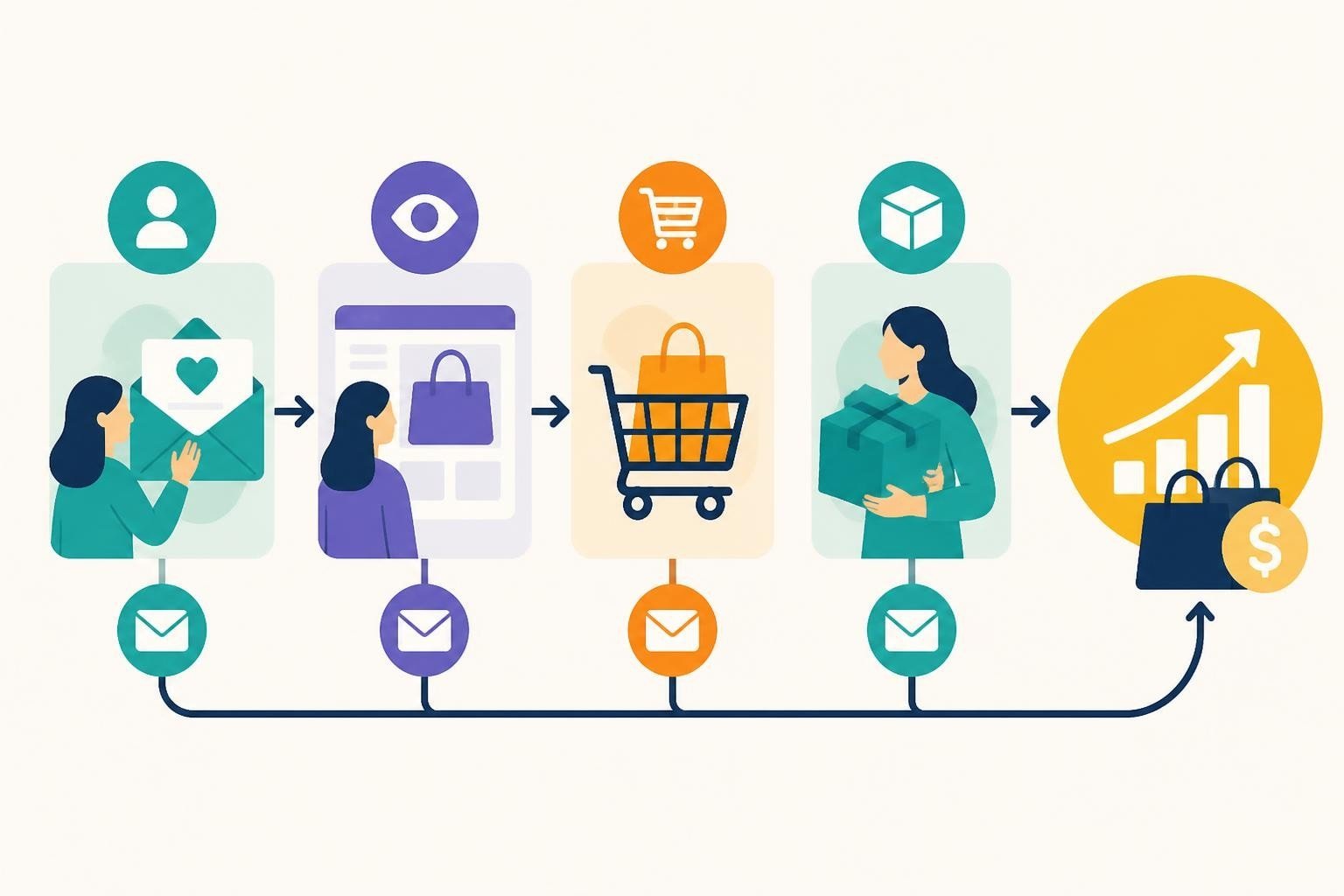
Email remains the highest-ROI channel for online stores, delivering an average return of $36 for every dollar spent. While social media drives discovery and engagement, email marketing for ecommerce transforms browsers into buyers and one-time customers into loyal advocates. The difference between struggling stores and thriving brands often comes down to how systematically they nurture their email list. This guide walks through the strategic framework, technical essentials, and advanced tactics that power profitable email programs in 2026.
Why Email Marketing Drives Ecommerce Revenue
Email owns your audience in ways that rented platforms never will. You control delivery, timing, and messaging without algorithm changes wiping out your reach overnight.
Owned channel benefits:
- Direct line to customers who opted in
- No platform fees per message sent
- Full control over creative and timing
- Rich behavioral and purchase data
The economics make sense too. Acquiring a customer costs five to twenty-five times more than retaining one, and email excels at both acquisition nurture and retention campaigns. According to Omnisend’s 2025 email marketing benchmarks, ecommerce brands see average open rates of 29% and click rates of 3.4%, with top performers doubling those numbers through segmentation and personalization.
The Revenue Multiplier Effect
Smart email programs don't just send promotional blasts. They create systematic touchpoints that guide customers through predictable profit pathways.
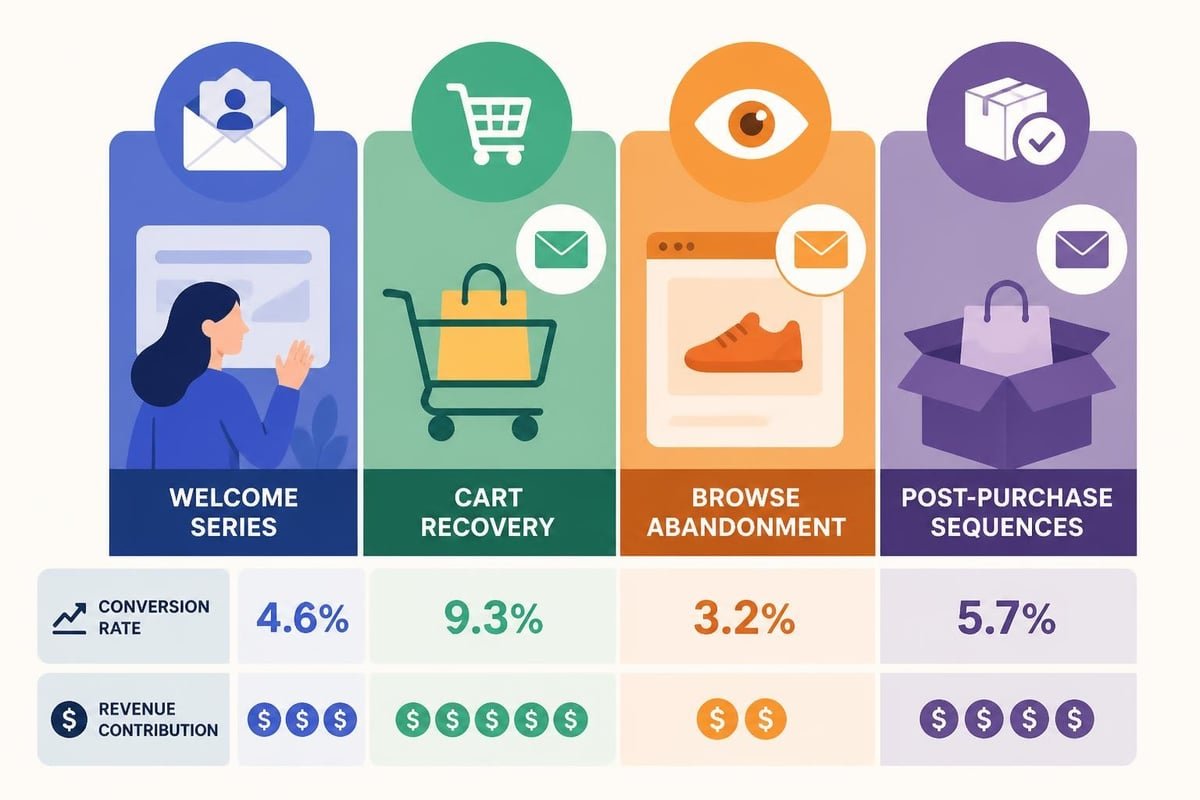
| Campaign Type | Average Revenue Impact | Typical Send Frequency |
|---|---|---|
| Welcome Series | 3-5x higher LTV | Triggered |
| Cart Recovery | 10-15% abandoned cart revenue | Triggered |
| Browse Abandonment | 2-8% conversion rate | Triggered |
| Post-Purchase | 20-40% repeat purchase lift | Triggered |
| Promotional | Variable (0.1-2% conversion) | 2-4/week |
| Win-back | 5-10% reactivation | Monthly |
Revenue concentration happens in automation, not broadcast. Triggered emails based on behavior generate 624% higher conversion than batch-and-blast campaigns.
Building Your Foundation: List Growth and Compliance
No list, no revenue. Growing a permission-based email database requires strategic placement of opt-in opportunities across every customer touchpoint.
High-converting capture points:
- Exit-intent popups with discount incentives (typically 2-5% conversion)
- Post-purchase receipt signup (40-60% opt-in rate)
- Content upgrades and buying guides
- SMS-to-email cross-promotion
- Social bio links and pinned posts
The offer matters more than the form. Generic "Join our newsletter" converts at 0.5-2%, while specific value propositions ("Get 15% off your first order plus early access to new releases") hit 5-12% depending on traffic quality.
Compliance and Deliverability Hygiene
Building a compliant list protects both your sender reputation and legal standing. CAN-SPAM, GDPR, and CASL establish baseline requirements, but ISPs add their own invisible scoring.
Non-negotiable compliance elements:
- Clear opt-in disclosure before collection
- Confirmation process (single or double opt-in)
- Visible unsubscribe link in every message
- Physical mailing address in footer
- Honor unsubscribe requests within 10 days
Authentication protocols (SPF, DKIM, DMARC) separate legitimate senders from spammers. Validity’s 2025 Email Deliverability Benchmark Report shows that properly authenticated domains see 15-20% higher inbox placement than unauthenticated ones.
Choosing the right platform matters more than most businesses realize. When evaluating email tools, look beyond headline features to real-world costs at your list size, API limits, automation depth, and support responsiveness. An email marketing platform comparison that shows actual pricing tiers, sending quotas, and workflow capabilities helps you match your needs to platform strengths without overpaying for unused features.
Segmentation: Moving Beyond Batch and Blast
Generic emails to your entire list waste opportunity and erode engagement. Strategic segmentation divides your audience into groups that receive contextually relevant messages.
Behavioral Segmentation Models
Purchase behavior reveals intent better than demographics ever could. Segment on actions, not assumptions.
- Purchase frequency: One-time buyers vs. repeat customers vs. VIP multi-purchasers
- Category affinity: Which product lines does each subscriber browse and buy?
- Engagement level: Active openers vs. dormant subscribers vs. at-risk churners
- Lifecycle stage: New subscribers vs. first-purchase vs. established customers vs. lapsed
Advanced segmentation combines multiple criteria. "Customers who purchased skincare in the last 60 days AND opened at least 2 emails in the last 30 days AND have not purchased in the last 21 days" creates a precise retargeting group for a limited-time serum promotion.
RFM (Recency, Frequency, Monetary) analysis automatically scores customers based on how recently they purchased, how often, and how much they spend. This creates natural segments:
| RFM Segment | Characteristics | Email Strategy |
|---|---|---|
| Champions | Bought recently, often, high value | Exclusive previews, loyalty rewards |
| Loyal Customers | Buy regularly, moderate spend | Cross-sell, category expansion |
| At Risk | Haven't purchased recently, were active | Win-back offers, feedback requests |
| Lost | Long dormant, low engagement | Sunset sequences, re-permission |
The email marketing for ecommerce strategy that wins treats different customers differently. Your best customers deserve VIP treatment and first access. Your at-risk segment needs reactivation incentives.
Automation That Scales Personal Touch
Triggered workflows deliver the right message at exactly the right moment without manual intervention. These sequences run 24/7, nurturing thousands of customers simultaneously.
Essential Ecommerce Automations
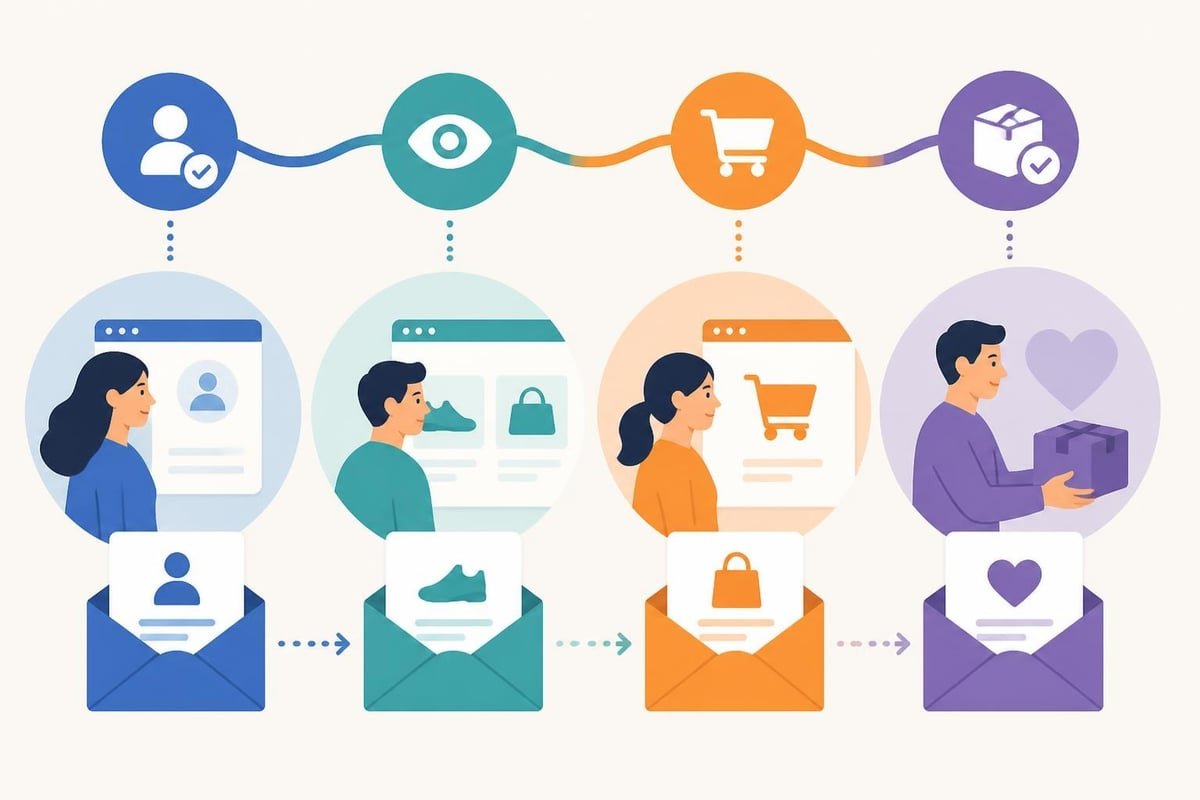
Shopify’s guide to automated email campaigns breaks down the sequences every store should deploy. Here's the execution framework:
1. Welcome Series (Triggered: New subscriber)
- Email 1: Immediate delivery, introduce brand story + discount code
- Email 2: Day 2, bestsellers and social proof
- Email 3: Day 5, educational content or buying guide
- Email 4: Day 7, final discount reminder if no purchase
2. Browse Abandonment (Triggered: Product page visit, no add-to-cart)
- Email 1: 2-4 hours after exit, showcase viewed product with related items
- Email 2: 24 hours later, urgency element (low stock, limited time)
3. Cart Recovery (Triggered: Abandoned checkout)
- Email 1: 1 hour after abandonment, simple reminder
- Email 2: 24 hours later, add social proof or reviews
- Email 3: 48-72 hours later, incentive if needed (10% off, free shipping)
4. Post-Purchase Nurture (Triggered: Order confirmation)
- Email 1: Shipment notification with tracking
- Email 2: Delivery confirmation + care instructions
- Email 3: 7-14 days post-delivery, review request
- Email 4: 30-45 days post-purchase, replenishment or complementary products
Timing optimization matters. Cart abandonment emails sent within the first hour convert 6-8% higher than those sent 24 hours later. Product recommendation emails perform best 3-7 days after delivery when the customer has experienced their purchase.
Dynamic Content and Personalization
Move beyond "Hi [First Name]" to content that adapts based on what each subscriber has done.
- Product recommendations: Show items based on browsing and purchase history
- Inventory alerts: "The item in your cart is now back in stock"
- Geo-targeting: Show different shipping promotions or store locations by region
- Weather triggers: Promote seasonal items based on local forecast
- Countdown timers: Create urgency with real-time sale end times
Machine learning recommendation engines analyze collective behavior to predict what individual customers want next, often surfacing products they hadn't considered.
Content Strategy: What to Send and When
Promotional fatigue kills engagement faster than poor design. Balance revenue-driving campaigns with value-building content.
The Email Content Mix
| Content Type | Purpose | Frequency | Conversion Goal |
|---|---|---|---|
| Educational | Build authority, solve problems | 2-3/month | Long-term trust |
| Promotional | Drive immediate sales | 2-4/week | Short-term revenue |
| Curated | Share useful third-party resources | 1-2/month | Engagement |
| User-generated | Social proof, community | 1-2/month | Trust + conversion |
The 80/20 rule applies: 80% value, education, and entertainment; 20% direct promotion. But "value" can include new arrival announcements for engaged customers who want to see fresh inventory.
Subject Line Science
Your subject line determines whether anyone sees your carefully crafted content. Litmus’s ecommerce email marketing guide emphasizes mobile-first thinking since 46% of email opens happen on smartphones.
Proven subject line frameworks:
- Urgency: "24 hours left: Extra 25% off sale items"
- Curiosity: "The one ingredient dermatologists avoid"
- Personalization: "Sarah, your cart misses you"
- Social proof: "Why 10,000+ customers choose this serum"
- Benefit-focused: "Get better sleep tonight (naturally)"
Subject lines under 50 characters avoid mobile truncation. Testing different approaches reveals what resonates with your specific audience. A/B test one variable at a time: emoji vs. no emoji, question vs. statement, urgency vs. benefit.
Design and Technical Execution
Beautiful emails that don't render properly or load slowly destroy conversion. Technical excellence matters as much as creative brilliance.
Mobile-First Design Principles
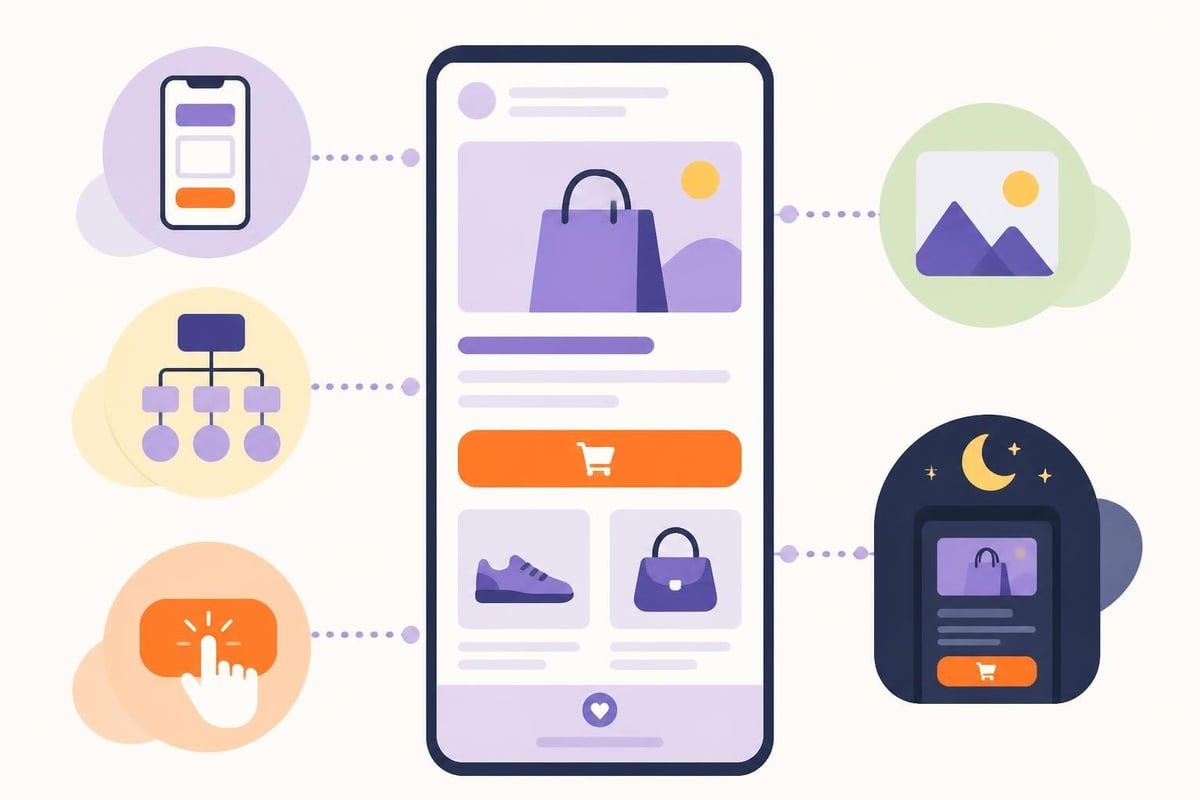
With nearly half of all opens on mobile devices, desktop optimization alone fails.
- Single-column layouts ensure readability on small screens
- Minimum 14px font size for body text
- Touch-friendly CTA buttons (44x44px minimum)
- Compressed images that load under 3 seconds on 4G
- Dark mode optimization (test on iOS and Android)
Responsive design adapts layout based on screen size. Use media queries to stack elements vertically on mobile while maintaining multi-column layouts on desktop.
Testing and Quality Assurance
Send yourself a test. Then send tests to Gmail, Outlook, Apple Mail, and Yahoo. Rendering engines interpret HTML differently, creating inconsistent displays.
Pre-send checklist:
- Test all links (especially personalization tokens)
- Preview in 6+ email clients
- Check alt text on images
- Verify unsubscribe link functions
- Review spam score (aim below 5.0)
- Confirm from-name and reply-to address
- Mobile preview on actual devices
Litmus and Email on Acid provide cross-client testing that catches rendering issues before your customers see them. Broken templates in Outlook or garbled text in Gmail costs sales.
Metrics That Matter: Measuring What Moves Business
Vanity metrics feel good but don't pay bills. Track measurements that connect to revenue.
Core KPIs for Email Marketing for Ecommerce
Deliverability metrics:
- Delivery rate (target: >95%)
- Bounce rate (hard bounces <2%, total <5%)
- Spam complaint rate (<0.1%)
Engagement metrics:
- Open rate (ecommerce average: 29%, target: 35%+)
- Click-through rate (average: 3.4%, target: 5%+)
- Click-to-open rate (average: 12%, target: 15%+)
Revenue metrics:
- Conversion rate (average: 1.5-3%, top performers: 5%+)
- Revenue per email (RPE)
- Revenue per subscriber (monthly)
- Email attribution (% of total revenue)
List growth rate, unsubscribe rate, and engagement decay help predict future performance. If unsubscribes exceed 0.5% per campaign, you're mailing too frequently or sending irrelevant content.
Attribution and Revenue Tracking
Email rarely gets full credit in multi-touch customer journeys. Someone might discover your brand on social media, research on Google, receive cart abandonment emails, then purchase weeks later through a retargeting ad.
First-click attribution credits the initial touchpoint. Last-click credits the final touchpoint. Multi-touch models distribute credit across the journey. Most ecommerce platforms default to last-click, undervaluing email's influence.
UTM parameters on all email links enable accurate tracking in Google Analytics. Structure them consistently:
- utm_source=email
- utm_medium=email
- utm_campaign=[campaign_name]
Compare assisted conversions (email was in the path) vs. last-click conversions (email was the final touch) to understand email's full contribution.
Advanced Tactics for Mature Programs
Once core automations run smoothly, these advanced strategies extract additional margin.
Predictive Sending and AI Optimization
Send-time optimization algorithms analyze individual open patterns to deliver each email when that specific subscriber is most likely to engage. Someone who consistently opens at 7 AM receives morning sends; evening openers get evening delivery.
Predictive analytics identify:
- Churn probability (who's likely to stop buying)
- Next-purchase timing (when they'll buy again)
- Product affinity (what they'll buy next)
- Lifetime value projections
These predictions enable preemptive intervention. Reach at-risk customers before they churn with targeted win-back offers.
Omnichannel Coordination
Email doesn't exist in isolation. Coordinate messaging across channels for consistent customer experience.
Email + SMS: Recover abandoned carts via email, follow with SMS 4-6 hours later if no action
Email + Retargeting: Suppress ads to customers who already converted via email
Email + Social: Include user-generated content from Instagram in email, drive email subscribers to exclusive social group
Many businesses building email lists simultaneously grow their social presence. Just as email platforms require evaluation on pricing and features, comparing social media growth services helps identify which providers deliver authentic engagement across Instagram, TikTok, YouTube, and other platforms at transparent prices.
Progressive Profiling and Zero-Party Data
Every form field reduces conversion. Instead of asking for everything upfront, collect information progressively over time.
- Initial signup: Email only
- Welcome email: "Which products interest you?" preference center
- Post-purchase: "How did you hear about us?"
- Follow-up email: Birthday for special offers
Zero-party data (information customers intentionally share) powers personalization more effectively than inferred behavior. Preference centers let subscribers choose email frequency, content topics, and product categories.
Platform Selection and Technical Stack
The right tools amplify effort; wrong tools create friction and wasted budget.
Essential Platform Capabilities
Must-have features:
- Robust automation builder (if/then logic, delays, splits)
- Segmentation based on behavior and custom fields
- A/B testing (subject lines, content, send times)
- E-commerce integrations (Shopify, WooCommerce, BigCommerce)
- Reporting on revenue and conversion
Nice-to-have features:
- Predictive sending optimization
- Dynamic content blocks
- Advanced personalization
- SMS integration
- Dedicated IP (for high-volume senders)
Pricing models vary wildly. Some charge by subscribers, others by emails sent, some by features unlocked. A platform that's cheap at 1,000 subscribers might become expensive at 50,000. HubSpot’s ecommerce email marketing tools overview breaks down how major platforms stack up on automation depth, deliverability, and price-to-value ratio.
Evaluate total cost of ownership including:
- Base subscription fee
- Overage charges (exceeding subscriber or send limits)
- Implementation and migration costs
- Staff training time
- Integration or API limitations
Deliverability: Getting Past the Gatekeepers
Perfect emails trapped in spam folders generate zero revenue. ISPs (Gmail, Outlook, Yahoo) deploy sophisticated filters to protect users from unwanted mail.
Sender Reputation Factors
Your sender reputation score (0-100) determines inbox placement. ISPs calculate it based on:
Engagement signals (positive):
- Opens and clicks
- Replies to emails
- Moving email from spam to inbox
- Adding sender to contacts
Spam signals (negative):
- High bounce rates
- Spam complaints
- Low engagement over time
- Sudden volume spikes
- Spam trap hits
Warming up a new domain or IP requires gradually increasing send volume over 4-8 weeks. Start with most engaged subscribers, then expand to broader list segments.
List Hygiene and Maintenance
Dead addresses and inactive subscribers drag down deliverability. Regular cleaning keeps lists healthy.
Quarterly maintenance tasks:
- Remove hard bounces immediately (invalid addresses)
- Suppress chronic non-openers after 6-12 months
- Run re-engagement campaigns before sunset
- Verify new signups (double opt-in)
- Monitor for spam traps and honeypots
Purchased lists, scraped emails, and rented databases destroy sender reputation and violate platform terms of service. Organic growth takes longer but builds an asset, not a liability.
Seasonal Campaigns and Promotional Calendar
Ecommerce email marketing for ecommerce revenue clusters around key shopping periods. Strategic planning maximizes these peaks.
Annual Campaign Calendar
| Period | Campaign Focus | Typical Volume | Strategy Notes |
|---|---|---|---|
| January | New year/resolutions | Normal | Fresh start themes, wellness |
| February | Valentine's Day | +40% | Gift guides, last-minute shipping |
| March-April | Spring/Easter | +20% | Seasonal transitions, renewal |
| May | Mother's Day | +50% | Gift focus, expedited shipping |
| June | Father's Day, summer | +30% | Outdoor, travel, gifts |
| July | Mid-year sales | Normal | Inventory clearance |
| September | Back to school | +35% | Organization, fresh starts |
| Oct-Nov | Halloween, BFCM | +200% | Biggest revenue period |
| December | Holiday, year-end | +150% | Gifts, shipping deadlines |
Black Friday/Cyber Monday planning starts in September. Segment strategies by customer tier: VIP early access, general subscribers day-of discounts, non-purchasers deeper discounts.
Campaign Fatigue Management
More emails during peak periods risk list burnout. Combat fatigue by:
- Increasing value per email (better offers, more exclusive content)
- Clear preference options ("Receive daily deals" vs. "Weekly digest only")
- Suppression rules (don't send promotional if they just purchased)
- Sunset non-engaged subscribers before peak season
Email marketing for ecommerce transforms casual browsers into loyal customers through strategic automation, behavioral targeting, and consistent value delivery. The tactics covered-from foundational list building through advanced predictive optimization-create systematic revenue growth when implemented thoughtfully.
While email builds direct relationships with customers, many ecommerce businesses also leverage social media to drive initial discovery and brand awareness. If you're evaluating providers for authentic followers, engagement, or views across Instagram, TikTok, YouTube, and other platforms, check out our comprehensive Best Social Media Growth Services 2026 comparison. It features live pricing calculators, delivery speed benchmarks, and platform coverage comparisons to help you choose the right service for your growth goals.