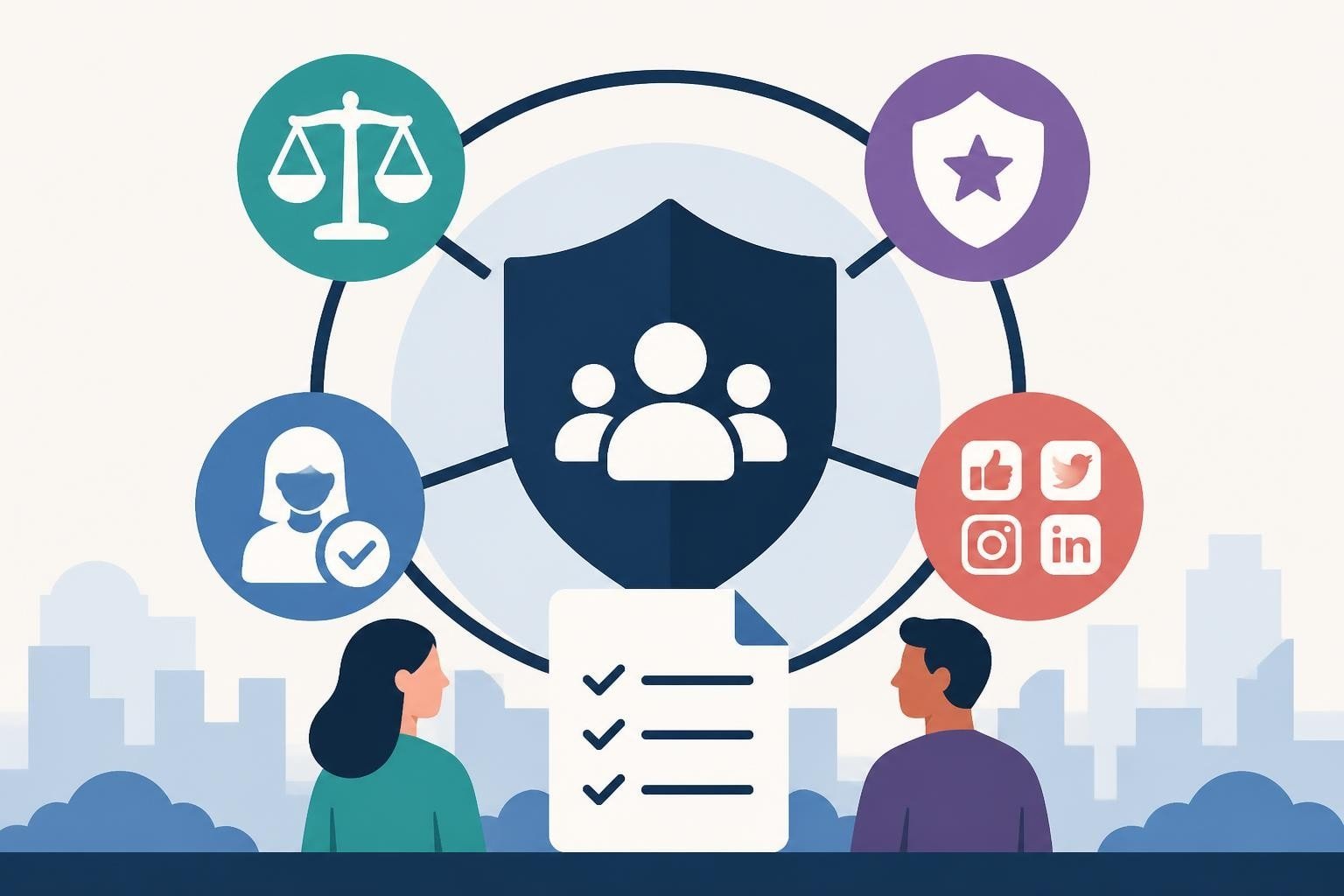
Every organization that maintains a digital presence needs clear rules governing how employees, partners, and stakeholders represent the brand online. A comprehensive social media policy protects your reputation, ensures legal compliance, and empowers your team to engage authentically while avoiding costly mistakes. Whether you manage a startup's single account or oversee enterprise-level social strategies, establishing written guidelines for online conduct has become a business necessity in 2026. Companies investing in social media marketing to build followers and engagement need especially clear policies to protect their growing digital assets.
Why Your Organization Needs a Social Media Policy
Organizations face unprecedented scrutiny for everything published under their name. A single poorly worded tweet, an unauthorized endorsement, or confidential information shared in a LinkedIn update can trigger legal action, regulatory fines, or permanent brand damage.
Key risks a policy mitigates:
- Disclosure violations and FTC enforcement actions
- Data privacy breaches under GDPR, CCPA, and similar regulations
- Copyright and trademark infringement claims
- Defamation lawsuits from employees or third parties
- Loss of trade secrets through accidental exposure
- Discrimination or harassment complaints stemming from social posts
According to Pew Research Center data on social media use, approximately 72% of American adults actively use at least one social platform. This ubiquity means your employees, contractors, and partners are constantly online, making informal statements that can be attributed to your organization. Clear written guidelines establish expectations before problems emerge.
Legal and Regulatory Requirements
Multiple regulatory frameworks now impose specific social media obligations on businesses. The Federal Trade Commission requires clear disclosure of material connections when employees endorse products, discuss partnerships, or promote your services online. Failure to properly disclose these relationships can result in fines exceeding $50,000 per violation in 2026.
Financial services firms, healthcare providers, and government agencies face additional sector-specific requirements. FINRA, HIPAA, and Freedom of Information Act obligations all extend into social media communications, requiring specialized policy language beyond general corporate guidelines.
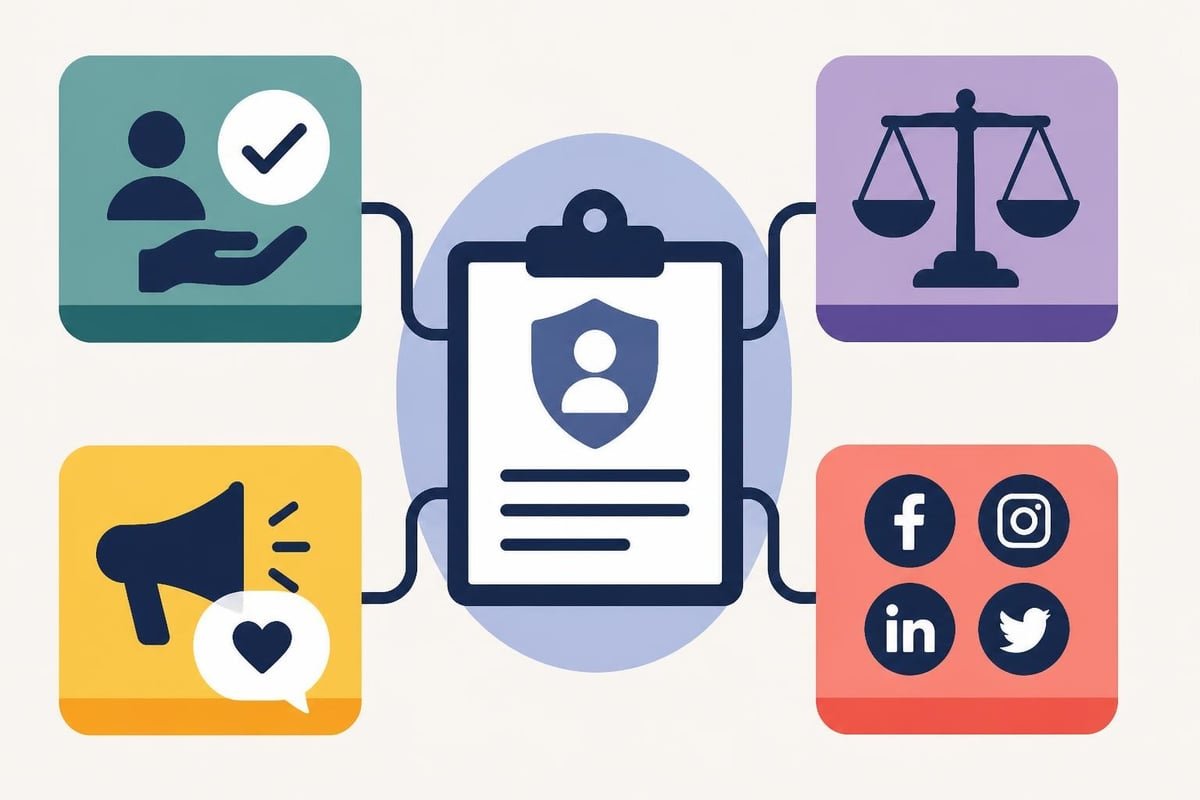
Essential Components of an Effective Social Media Policy
Your social media policy should function as both a protective framework and an enablement tool. Structure it to answer the practical questions employees encounter daily while establishing clear boundaries around prohibited conduct.
Personal vs. Professional Account Guidance
Most employees maintain personal social profiles separate from official company accounts. Your policy must address both contexts without overreaching into protected personal expression.
For personal accounts, specify:
- Required disclaimers when discussing work-related topics ("Opinions are my own")
- Prohibitions on sharing confidential business information
- Standards for respectful discussion even in personal capacity
- Guidance on mentioning the company name or associating with the brand
- Rules about posting during work hours using company devices
For official company accounts, define:
- Who is authorized to post and under what approval process
- Brand voice, tone, and visual identity standards
- Required legal reviews for specific content types
- Crisis communication protocols and chain of command
- Archiving and record retention requirements
The SHRM social media policy template provides practical HR-focused language that balances employee rights with organizational protection. Adapt their framework to your specific industry and risk profile rather than copying it verbatim.
Content Guidelines and Brand Standards
Consistency across channels builds trust and recognition. Your policy should translate your brand style guide into social-specific rules.
| Content Type | Policy Requirements | Approval Needed |
|---|---|---|
| Product announcements | Legal review, fact-checking, trademark compliance | Marketing director |
| Customer testimonials | Written consent, FTC disclosure, accurate attribution | Compliance team |
| Industry commentary | Factual accuracy, source citation, respectful tone | Department head |
| Employee spotlights | Written consent, photo rights, privacy considerations | HR and subject |
| Crisis responses | Coordinated messaging, legal review, executive approval | Crisis team |
Define what constitutes "confidential information" explicitly. Revenue figures, unreleased product details, customer lists, strategic plans, and personnel matters typically fall under this category. Employees need concrete examples to make real-time judgment calls.
Platform-Specific Rules
Different platforms carry different risks and serve different purposes. Your policy should acknowledge these distinctions rather than applying one-size-fits-all rules.
LinkedIn posts from executives may be encouraged for thought leadership, while the same individuals should avoid political commentary on Twitter. Instagram Stories from your retail location might showcase daily operations, while Facebook requires more formal, approved content. TikTok's younger demographic may demand different tone and approach than your LinkedIn presence.
Address emerging platforms explicitly. When new social networks gain traction, employees shouldn't have to guess whether existing policies apply. Include language like "These guidelines apply to all current and future social platforms, including but not limited to…" with a mechanism for adding platform-specific addenda.
Compliance and Disclosure Requirements
Regulatory compliance forms the foundation of any defensible social media policy. Multiple agencies now enforce social media conduct, with penalties increasing substantially in recent years.
FTC Endorsement and Disclosure Rules
The Federal Trade Commission's updated guidance requires "clear and conspicuous" disclosure whenever material connections exist between your organization and the person making a recommendation. This applies to employees, contractors, influencers, and anyone receiving compensation or free products in exchange for social mentions.
Required disclosures for:
- Employee posts about company products or services
- Sponsored content, paid partnerships, and affiliate relationships
- Posts by influencers or brand ambassadors receiving compensation
- Reviews by individuals who received free products
- Expert endorsements from paid consultants or advisors
Disclosure must appear before the "more" button on platforms that truncate content. Hashtags like #ad or #sponsored alone may not suffice if they're buried among many other hashtags. The FTC expects language a reasonable consumer would notice and understand.
Data Protection and Privacy Considerations
Social media policies intersect directly with data protection regulations. When employees discuss customers, share user-generated content, or respond to public inquiries, they process personal data subject to privacy law.
The UK Information Commissioner’s Office social media policy guidance addresses these intersections comprehensively, covering how to handle personal data in social contexts, respond to subject access requests received via social channels, and maintain compliance with data protection principles when engaging audiences online.
Privacy policy requirements:
- Never post customer information without explicit written consent
- Blur or redact personal details from screenshots and photos
- Obtain model releases before posting recognizable images
- Establish processes for deletion requests received via social channels
- Maintain separate documentation of consent for different uses
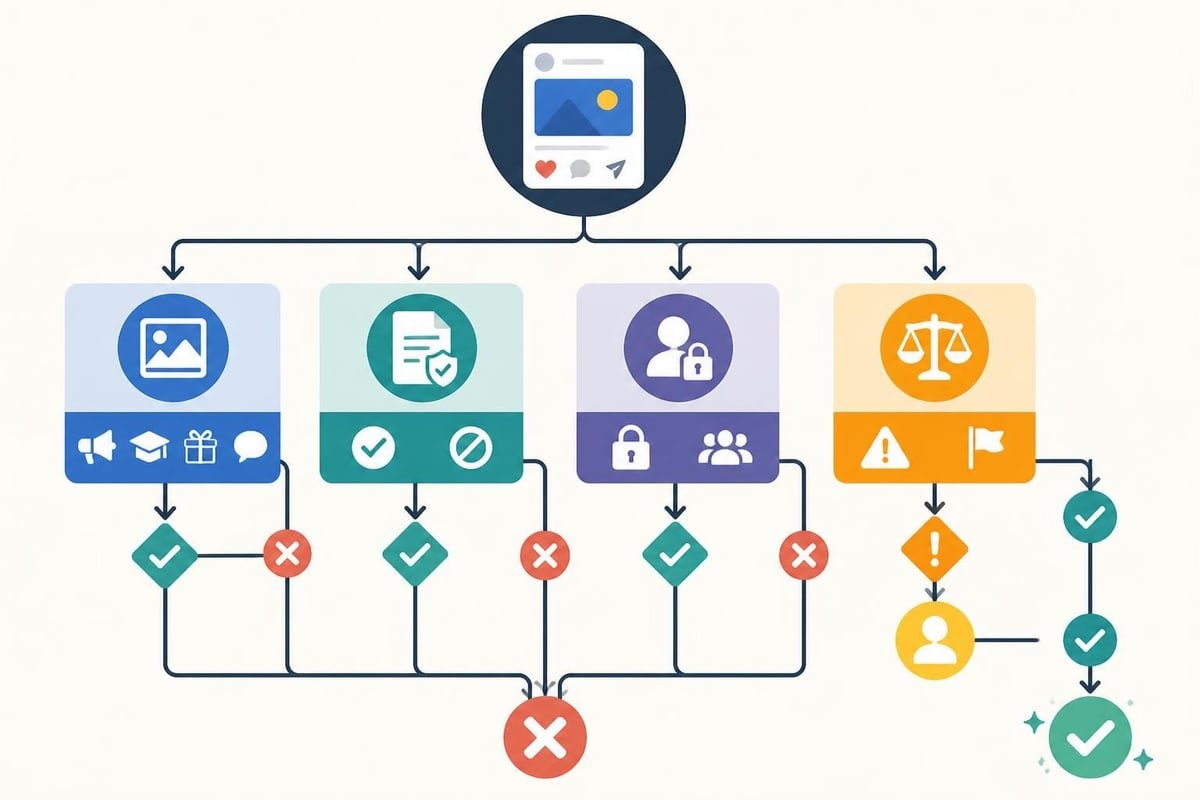
Security and Access Control
NIST cybersecurity guidance includes specific controls for social media use within organizational risk management frameworks. Treat social media credentials with the same security rigor as other business systems.
Implement these security requirements:
- Unique credentials for each authorized user (no shared passwords)
- Multi-factor authentication on all business accounts
- Immediate credential revocation when employees leave or change roles
- Regular access audits to remove dormant authorizations
- Encrypted storage of login credentials using password management tools
- Logging and monitoring of all posts for forensic purposes
Social media accounts represent valuable digital assets. An Instagram account with 500,000 followers or a YouTube channel with established monetization carries significant financial value. Protect these assets with the same diligence you'd apply to physical property or financial accounts.
Employee Training and Implementation
Even the most carefully written policy fails without effective training and consistent enforcement. Employees can't comply with rules they don't understand or haven't seen.
Onboarding and Ongoing Education
Incorporate social media policy training into new employee onboarding. Don't simply hand new hires a PDF to sign; walk through real scenarios and explain the reasoning behind each requirement.
Effective training includes:
- Interactive scenarios demonstrating proper disclosure language
- Examples of posts that violated policy and the resulting consequences
- Platform-by-platform demonstrations of privacy settings
- Role-specific guidance for departments with different social responsibilities
- Regular refresher training when policies update or incidents occur
Annual refresher training keeps the policy top-of-mind. Social platforms evolve constantly, introducing new features and changing privacy defaults. Schedule yearly updates that address emerging platforms, new regulatory requirements, and lessons learned from recent incidents.
Research from Harvard Business Review on social media policy implementation demonstrates that organizations with regular training programs experience 60% fewer policy violations than those that treat the policy as a one-time requirement.
Enforcement and Consequences
Clear consequences for policy violations create accountability. Your policy should specify escalating responses based on violation severity and intent.
| Violation Type | First Offense | Second Offense | Severe Violations |
|---|---|---|---|
| Minor (missed disclaimer) | Warning and retraining | Written reprimand | N/A |
| Moderate (unauthorized post) | Written reprimand | Suspension | N/A |
| Serious (confidential disclosure) | Suspension | Termination | Immediate termination |
| Illegal (harassment, discrimination) | Immediate termination | N/A | Legal action |
Document all violations and responses. This documentation protects you in wrongful termination claims and demonstrates consistent enforcement across the organization. Selective enforcement undermines the entire policy and creates legal liability.
Monitoring and Auditing
You can't enforce what you don't detect. Establish monitoring processes that balance employee privacy with organizational protection.
Public posts on official company accounts should be logged automatically. Many social media management platforms include native archiving features that capture every post, edit, and deletion for compliance purposes.
Private employee accounts present more complexity. Avoid broad social media surveillance that invades privacy or chills protected speech. Instead, respond to specific complaints or concerns, and rely on stakeholder reports when employee social media conduct becomes publicly problematic.
Special Considerations for Different Sectors
Industry-specific regulations often impose additional social media requirements beyond general business obligations. Tailor your policy to address your sector's unique compliance landscape.
Healthcare and HIPAA
Healthcare organizations must prevent unauthorized disclosure of protected health information (PHI) across all social channels. A seemingly innocent post celebrating a successful treatment could violate HIPAA if it reveals identifiable patient information.
Healthcare social media rules:
- Never photograph patients without written authorization specifying social use
- Avoid sharing details that could identify individuals even without names
- Establish separate review for any health-related claims or advice
- Train staff to recognize indirect identifiers (rare conditions, small communities)
- Implement immediate takedown procedures when violations occur
The World Health Organization’s guidance on combating misinformation provides valuable frameworks for healthcare organizations navigating social media's information challenges while maintaining public trust.
Financial Services and FINRA
Financial services firms operate under extensive communication regulations that extend to all social media activity. FINRA requires supervision of all business communications, including social posts, with specific retention and approval requirements.
Registered representatives can't recommend securities via social media without proper disclosures and supervisory approval. Customer testimonials must include specific disclaimers. Even "liking" a customer's positive comment about your services may constitute an endorsement requiring disclaimer language.
Government and Public Sector
Government agencies face unique constitutional constraints when managing social media. The ACLU’s analysis of public official social media use highlights First Amendment issues that arise when officials block constituents, delete comments, or restrict access to government social media accounts.
Public sector policies must:
- Preserve public comments as government records subject to FOIA
- Establish content-neutral moderation standards
- Avoid viewpoint discrimination when removing comments
- Archive deleted content with documentation of removal reasons
- Clarify personal vs. official capacity for elected officials

Crisis Management and Reputation Protection
Even organizations with excellent policies occasionally face social media crises. Your policy should include clear protocols for identifying, escalating, and responding to emerging problems.
Identifying and Escalating Issues
Define what constitutes a social media crisis for your organization. Thresholds vary by industry, size, and risk tolerance, but common triggers include:
- High volume of negative comments or mentions within short timeframes
- Media inquiries resulting from social media posts
- Posts alleging illegal conduct, safety issues, or discrimination
- Coordinated campaigns or hashtags targeting your organization
- Viral spread of misleading information about your products or services
Establish clear escalation paths. Frontline social media managers should know exactly who to notify when specific scenarios occur, with contact information for after-hours emergencies.
Response Protocols
Speed matters in crisis response, but accuracy matters more. Your policy should balance the need for quick acknowledgment with thorough fact-finding.
Crisis response framework:
- Acknowledge immediately (within 1-2 hours): Confirm you're aware and investigating
- Investigate thoroughly (2-6 hours): Gather facts before making substantive statements
- Respond substantively (6-24 hours): Address the issue with accurate information
- Update regularly: Provide additional information as situations develop
- Follow through: Report resolutions and corrective actions taken
Never delete posts or comments unless they violate clearly stated community standards (spam, harassment, illegal content). Deletions appear deceptive and often generate more controversy than the original problem.
Updating and Maintaining Your Policy
Social media policies require regular maintenance. Platforms change, regulations evolve, and new risks emerge constantly.
Schedule annual comprehensive policy reviews, with interim updates as needed when:
- New platforms gain significant user adoption
- Regulatory agencies issue updated guidance or new requirements
- Your organization experiences a social media incident revealing policy gaps
- Court decisions clarify employer rights or employee protections
- Your business model, products, or services change substantially
Track policy version history and ensure all employees acknowledge the current version. When significant changes occur, provide supplemental training rather than assuming employees will read updated documents on their own.
Maintain a living FAQ document that addresses common questions and edge cases that arise between formal policy updates. This helps employees navigate ambiguous situations without waiting for the next policy revision.
Balancing Protection and Empowerment
The most effective social media policies protect the organization without stifling authentic engagement. Overly restrictive policies that require excessive approvals for routine posts discourage social media use entirely, causing you to miss valuable opportunities for customer connection and brand building.
Empower employees to engage authentically within clear boundaries. Provide examples of encouraged content alongside prohibited topics. Celebrate employees who exemplify good social media citizenship to model desired behavior.
Consider tiered authorization levels. Customer service teams responding to routine inquiries need different permissions than executives sharing strategic insights or marketing teams launching campaigns. Match approval requirements to actual risk levels rather than applying uniform restrictions.
Some organizations successfully encourage employee advocacy by providing pre-approved content libraries employees can share. This approach combines brand consistency with individual authenticity when employees add personal context to shared company updates.
A well-crafted social media policy serves as both shield and guide, protecting your organization from avoidable risks while enabling your team to build authentic connections with your audience. By addressing legal requirements, establishing clear guidelines, providing thorough training, and maintaining regular updates, you create a framework that scales with your digital presence. Organizations building their social media reach can compare social growth providers to accelerate follower growth while maintaining the professional standards established in their social media policy.